






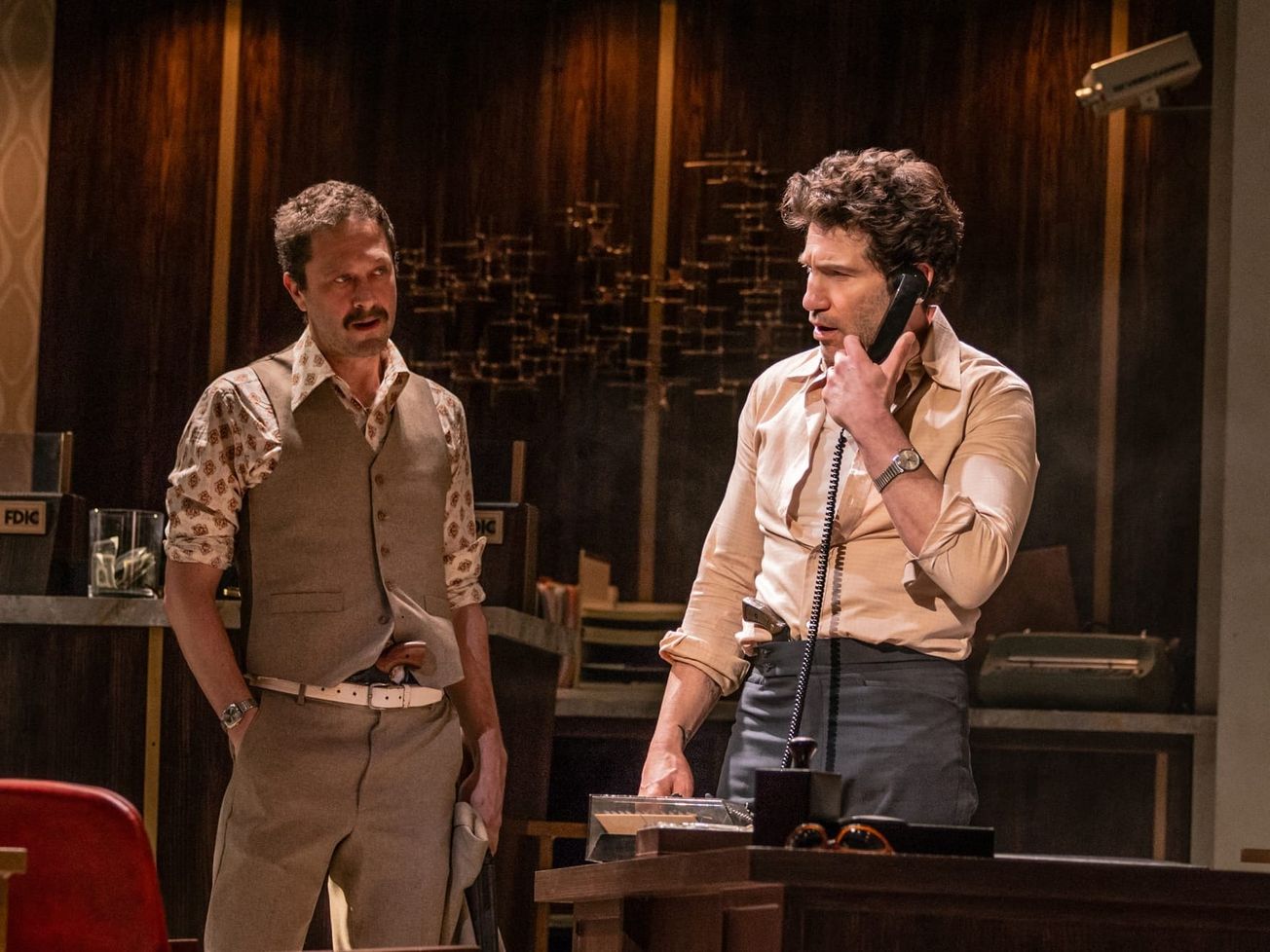
“Dog Day Afternoon” begins outside a Chase Manhattan Bank, specifically, as playwright Stephen Adley Guirgis notes in his script, “a Street outside the bank on Avenue P in Gravesend Brooklyn. It is August 22nd, 1972.” While playwrights are responsible for creating a detailed world for their works, the address and date aren’t arbitrary. This is the actual address and date of the real-life bank robbery that inspired the film “Dog Day Afternoon” and now the eponymous Broadway play.
The dramatization onstage and on-screen follows Sonny and Sal, two best friends who rob a Brooklyn bank in order to get enough money to pay for surgery for the love of Sonny’s life. In real life, these two men were John Wojtowicz and Sal Naturile. Onstage they’re played by Jon Bernthal and Ebon Moss-Bachrach, actors who in real life are also self-described best friends.
But the Broadway mounting is less a suspense thriller and more of a heartfelt comedy — as audiences watch Sonny and Sal’s bank robbery turn into a bumbling affair. What was supposed to be an in-and-out job becomes a hostage situation — with Sonny and Sal keeping the bank’s employees inside the branch. But that turns into more of a coffee klatch than a life-threatening condition, as Sonny’s congeniality shines.
“Dog Day Afternoon” began previews on March 10 before officially opening on March 30. Broadway News spoke to star Bernthal about his experience playing Sonny five weeks into the run (which ends on July 12) to hear about how the play and his performance have grown.
The interview has been edited for length and clarity.
Before Broadway, the story of “Dog Day Afternoon” wasn’t just from a movie script. It’s based on true events that were documented in Life magazine. I read the story and it’s wild. How much research did you do into the real Sonny, whose name was John Wojtowicz, rather than just knowing the film?
Bernthal: Quite a bit. I think it’s important [to know] the film because it’s such a seminal and sacred piece of the American zeitgeist. It's like on the Mount Rushmore of American cinema. I don’t think we were ever trying to make this an adaptation of the film. I think it was us trying to tell the story and, specifically, in this day and age, the why. To try to hone in on how far we’ve come since 1972 and the fact that, in many ways, we’ve not traveled any distance at all and even gone backwards. So the story itself is wild. It’s like truth is even stranger than fiction. It’s almost too wild. But I think for everything that I do, I always want to just really believe in it.
For me with this piece, what I really believe in is that: You only get one go-around in this thing [called life], and if you can be lucky enough — at the cost of defying the social norms and your familial pressures and the pressures that are put on us by the expectations of what we’re supposed to be, whether we’re a man or a woman or straight or gay — if you get this unbelievably glorious privilege of somehow fighting that back and finding out who you truly are, [that’s huge]. [That’s] what John, [in our version] Sonny, really was able to do in this teeny little nook and cranny of New York City and the West Village. He really had this ability, defying all odds, to really discover who he truly was and then to truly fall in love with this person. That’s something I could latch onto.